
Daly City, CA · 186 certified beds
1.0CMS rating
Skilled Nursing
Skilled Nursing market benchmark$11,600–$17,440/mo not this community's rate
View source record →
27 of the 127 communities Haven evaluates in the San Francisco, CAarea are certified to accept Medicaid, based on the federal Provider Type recorded by CMS. They're listed below in neutral name order with CMS facts kept as separate source fields — not by who pays us. Certification means the home participates in Medicaid; it does not mean a Medicaid bed is open today, and it does not cover assisted living.

Daly City, CA · 186 certified beds

Menlo Park, CA · 160 certified beds

Belmont, CA · 74 certified beds

San Mateo, CA · 96 certified beds
San Francisco, CA · 38 certified beds
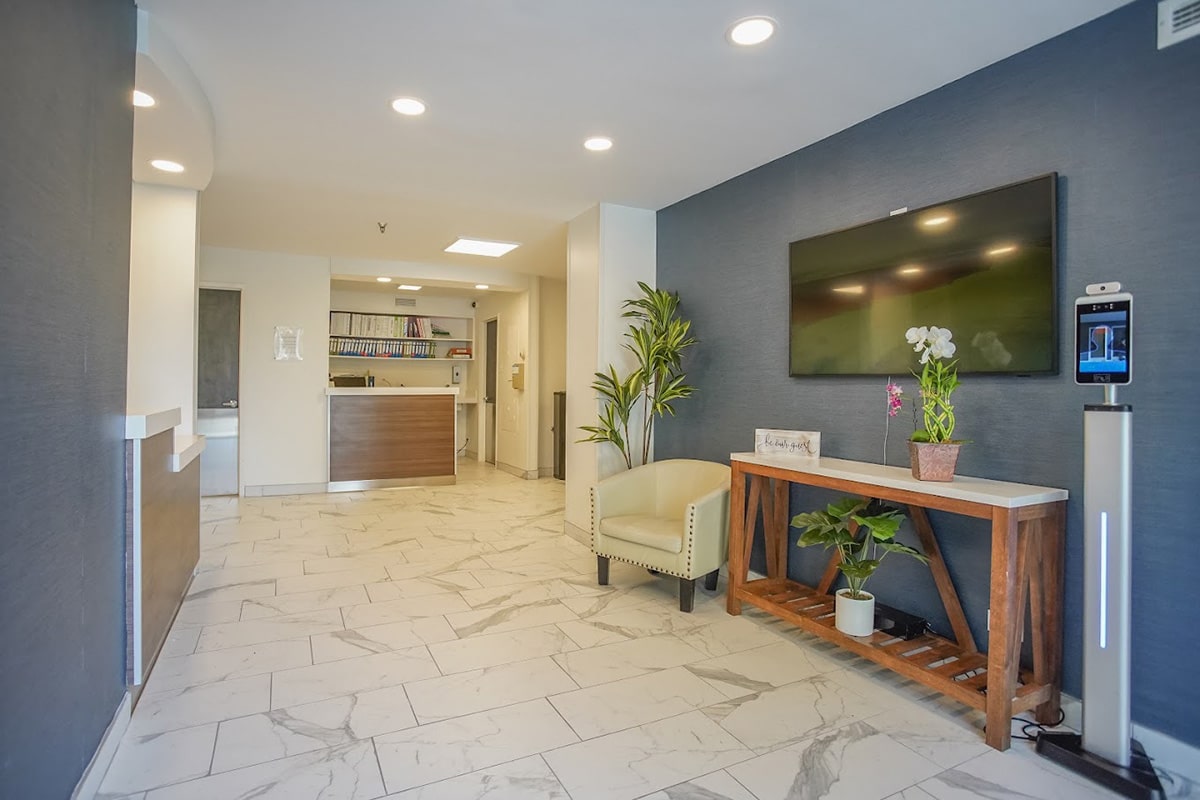
San Francisco, CA · 92 certified beds

San Francisco, CA · 23 certified beds

San Francisco, CA · 180 certified beds

Redwood City, CA · 38 certified beds
Daly City, CA · 102 certified beds
Daly City, CA · 239 certified beds

San Francisco, CA · 34 certified beds

San Francisco, CA · 362 certified beds

San Francisco, CA · 769 certified beds
San Francisco, CA · 68 certified beds

Pacifica, CA · 59 certified beds
Millbrae, CA · 140 certified beds
San Francisco, CA · 120 certified beds
Pacifica, CA · 68 certified beds

San Bruno, CA · 45 certified beds

San Francisco, CA · 168 certified beds
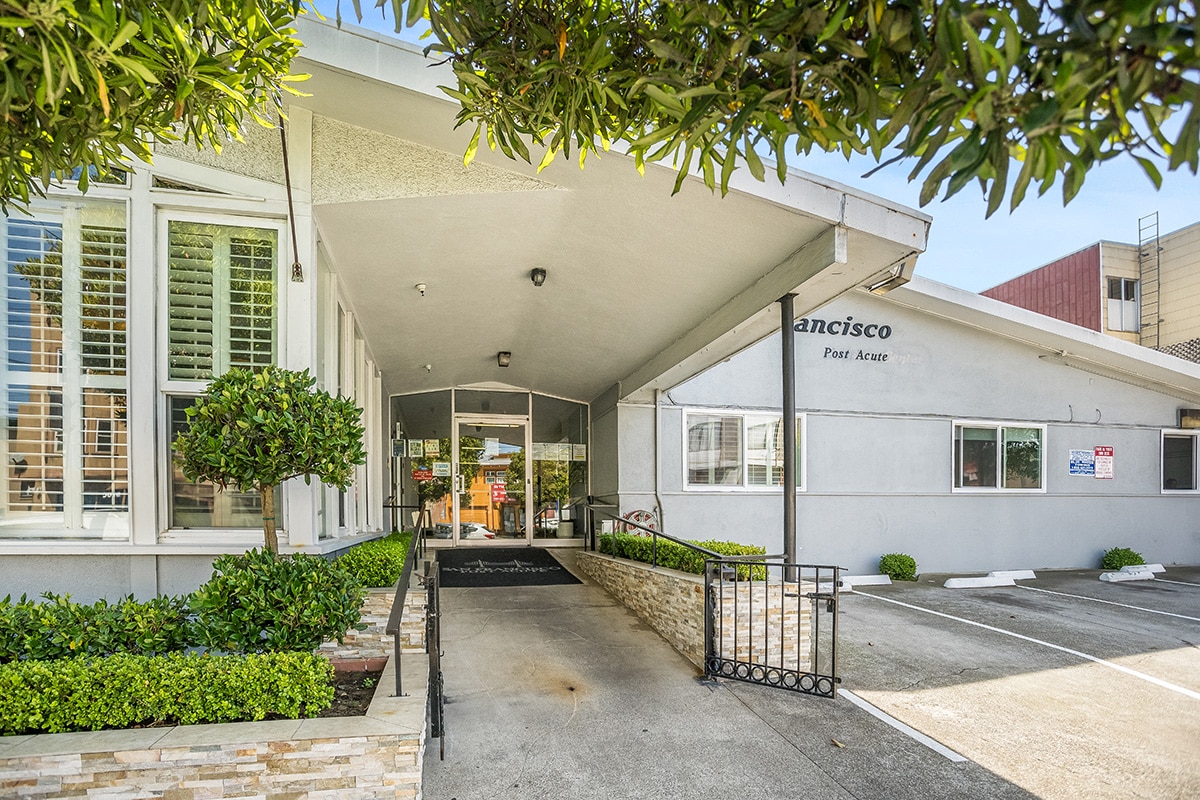
San Francisco, CA · 53 certified beds

San Mateo, CA · 345 certified beds
San Francisco, CA · 46 certified beds

San Francisco, CA · 140 certified beds

San Francisco, CA · 90 certified beds

San Francisco, CA · 30 certified beds
The list below is built from CMS certification data, the same federal source behind Medicare's Care Compare. A nursing home shows up here if it holds Medicaid certification, meaning a state survey agency has approved it to participate in Medicaid and be paid by the state Medicaid program for nursing facility services.
That is a real, useful fact. It is also a narrow one. Three things Medicaid certification does not tell you, and each one trips families up:
Certification is a fact about the building. Eligibility is a fact about your parent's finances. Availability is a fact about today. You need all three to line up, and this list only settles the first.
This is the single most common misunderstanding we hear, and it usually surfaces during a hospital discharge when the family is told "Medicare will cover the rehab." That is true, briefly.
Medicare Part A pays for short-term skilled nursing care after a qualifying hospital stay, capped at 100 days per benefit period. In 2026, you pay nothing per day for days 1 through 20 after the $1,736 Part A deductible, then $217 a day for days 21 through 100. After day 100, Medicare pays nothing. Medicare does not cover long-term custodial care, which is help with bathing, dressing, eating, and moving safely.
Medicaid is the program that actually pays for long-term nursing home care in the United States. It is need-based, jointly run by the federal government and your state, and there is no 100-day clock. Once someone is approved, Medicaid can pay for a nursing home stay indefinitely as long as they continue to meet the state's clinical and financial rules.
The practical translation: Medicare buys you rehab and a few weeks to plan. Medicaid is the long-term answer. Families who assume Medicare rolls into permanent coverage often find out around day 90, which is a bad week to start a Medicaid application. Our guide to paying for senior care walks through the other funding sources, and if the person is a veteran or a surviving spouse, check VA benefits too.
Usually not the way families hope, and this is worth reading slowly.
Federal rules bar Medicaid from paying room and board in home and community-based settings. Under 42 CFR 441.310(a)(2), federal matching funds are not available for the cost of room and board in waiver services, with narrow exceptions for respite care and live-in caregivers. Rent, meals, and utilities in an assisted living community are the family's cost.
What many states do cover is the care portion. Most states run Home and Community-Based Services (HCBS) waivers that can pay for personal care, medication management, and supervision delivered inside an assisted living community. These waivers are optional for states, so they differ enormously: different names, different income tests, different service packages, waiting lists in some states, and only a subset of assisted living communities that accept them.
So a fair summary is this. Medicaid pays for nursing home care as a mandatory benefit. Medicaid may help pay for care services in assisted living or memory care through a state waiver, but almost never for the rent. If cost is the deciding factor, start by comparing real numbers in our cost of senior living tables, then call your state Medicaid agency or Area Agency on Aging to ask which waiver applies where you live.
Eligibility has two halves: a clinical test and a financial test. The clinical test asks whether the person needs a nursing facility level of care, which the state assesses. The financial test is where most of the anxiety lives.
Income limits. Many states cap monthly income for nursing home Medicaid at 300% of the SSI federal benefit rate, which works out to roughly $2,982 a month for a single applicant in 2026. Other states use a completely different standard, and some have no hard income cap at all but require you to spend income down toward the cost of care. There is no single national number, so confirm yours with the state agency.
Asset limits. The countable asset limit for a single applicant is $2,000 in a large number of states, but several states are far more generous, and California reinstated its own much higher limit in 2026. A home, one vehicle, personal belongings, and certain burial funds are typically not counted, though home equity above a federal threshold can disqualify an applicant. For 2026, that home equity limit is $752,000 in most states, and states may elect a higher ceiling of up to about $1,130,000.
The look-back period. When someone applies, the state reviews asset transfers made during a look-back window. Federal law sets it at 60 months for transfers made on or after February 8, 2006. Gifts or below-market sales inside that window can trigger a penalty period of ineligibility, calculated by dividing the uncompensated value transferred by the state's average monthly private-pay nursing home cost. States are not allowed to round the resulting fractional months down. A handful of states operate on different terms, and California's rules changed again in 2026, so verify before assuming.
Spousal protections. If one spouse enters a nursing home and the other stays home, federal spousal impoverishment rules keep the at-home spouse from being left with nothing. In 2026, the community spouse can keep up to $162,660 in protected resources, and the maximum monthly maintenance needs allowance is $4,066.50. States set their own protected amount within the federal floor and ceiling, so the figure that applies to you depends on where you live.
One thing worth saying plainly: this is where a certified elder law attorney or a free State Health Insurance Assistance Program (SHIP) counselor earns their keep. Do not restructure assets based on a website, including this one.
"Medicaid pending" means the application has been filed with the state but not yet approved. Some nursing homes will admit a resident on that basis, betting the approval comes through and the state pays retroactively.
Sometimes that works and is genuinely the right move, especially when a hospital discharge cannot wait. But understand what you are taking on. Applications get denied for excess assets, unreported transfers inside the look-back window, or missing documentation, and processing can stretch for months. If the application is denied, someone owes the facility for every day of care already delivered, at private-pay rates.
Federal rules give you some protection here. A certified nursing facility may not require a third-party guarantee of payment as a condition of admission or continued stay, may not ask you to waive your Medicare or Medicaid rights, and may not require an oral or written assurance that the resident is not eligible for or will not apply for Medicaid. Those rules do not erase the underlying debt, and a facility can still pursue discharge for nonpayment after proper notice.
If you go in pending, do it with your eyes open: get the admission agreement in writing, ask exactly what happens if the application is denied, ask who signs and in what capacity, and have the application reviewed by someone who does this for a living before you file.
Families call a facility on this list, hear "we're not taking Medicaid right now," and assume the data is wrong. It usually is not.
CMS publishes the number of certified beds at a facility. That is a licensing and certification count, not a live vacancy feed. Occupancy shifts weekly. Some buildings are certified for both Medicare and Medicaid, some for one or the other, and some certify only a distinct part of the building. A facility can be fully Medicaid-certified and still have zero beds free this week.
There is also a business reality. Medicaid typically reimburses less than private pay, so some facilities manage their payer mix and prefer admissions that start as private pay or Medicare rehab. Federal rules require a certified facility to provide equal access to quality care regardless of payment source, and to give residents information about how to apply for Medicare and Medicaid. But nothing requires a facility to hold a bed open for you.
Practical approach: build a list of six to ten certified facilities from below, call all of them in the same week, and ask about availability in the specific terms in the next section. Availability changes fast enough that a two-week-old answer is not an answer.
Ask these on the phone before you spend a morning touring. Write down the name of the person who answers.
Bring the same skepticism to quality that you bring to billing. A facility with an open Medicaid bed and a one-star rating is not a bargain. Check the CMS ratings and inspection history on the listing, read how CMS star ratings work so you know what the number is measuring, and see our methodology for how these nursing-home comparisons are displayed.
Below are the Medicaid-certified nursing homes in {Metro}, drawn from CMS federal certification data and shown in neutral name order. CMS stars, inspection, staffing, and quality fields remain separate source facts; no facility can pay to alter them or its public-record order.
If you are not certain a nursing home is the right level of care, take the free two-minute care assessment first. Many families arrive convinced they need skilled nursing and find that assisted living or memory care fits better, which changes the funding conversation completely.
Haven's public research tools are free for families. This deployment does not accept family requests or make referrals, so no placement fee or payment path is active. Haven does not promise a live Medicaid bed, a response time, or a local referral service. Use this CMS-certified list to prepare calls, then confirm each home's Medicaid-pending policy, current opening, and care acceptance directly with the home. You can also browse other metros if you are looking outside {Metro}.
One last note. If a facility tells you something that contradicts what you read here, get it in writing and check it with your state Medicaid agency. Rules genuinely differ by state, and the person on the phone may be describing their own policy rather than the law.
27 of the 127 communities Haven evaluates in the San Francisco, CA area are certified to accept Medicaid, according to the federal Provider Type recorded by the Centers for Medicare & Medicaid Services. Certification means the nursing home participates in Medicaid — it does not guarantee a Medicaid bed is open today.
No. Participating in Medicaid is voluntary for a nursing home. A facility must be certified by a state survey agency to be paid by Medicaid, and facilities that are not certified can decline Medicaid entirely. Even at a Medicaid-certified nursing home, there is no requirement to have a bed open for a Medicaid applicant on any given day. Federal rules do require certified facilities to provide equal access to quality care regardless of payment source, and to give residents written and oral information about how to apply for Medicare and Medicaid.
Medicaid does not pay for room and board in assisted living. Federal regulation at 42 CFR 441.310(a)(2) bars federal matching funds for room and board in home and community-based waiver services, with narrow exceptions. Many states do cover the care services delivered inside assisted living, such as personal care and medication management, through optional Home and Community-Based Services (HCBS) waivers. Those waivers vary by state, may have waiting lists, and are accepted by only some communities. Medicaid coverage of nursing home care is different: nursing facility services are a mandatory Medicaid benefit and can include room and board.
You have to meet two tests. The clinical test asks whether the person needs a nursing facility level of care, which the state assesses. The financial test looks at income and countable assets. Many states cap monthly income at 300% of the SSI federal benefit rate, roughly $2,982 a month for a single applicant in 2026, while other states use a different standard or a spend-down. The countable asset limit for a single applicant is $2,000 in many states, though several states are considerably higher. A home, one car, personal belongings, and certain burial funds are typically excluded, but home equity above the 2026 limit of $752,000 (up to about $1,130,000 in states that elected the higher ceiling) can disqualify an applicant. Because limits vary by state, confirm the numbers with your state Medicaid agency before making any financial moves.
When someone applies for nursing home Medicaid, the state reviews asset transfers made during a look-back window. Federal law sets that window at 60 months for transfers made on or after February 8, 2006. Gifts or sales below fair market value inside the window can trigger a penalty period during which Medicaid will not pay, calculated by dividing the total uncompensated value transferred by the state's average monthly private-pay nursing home cost. States are not permitted to round fractional penalty months down. A small number of states operate on different terms, and California's rules changed in 2026, so verify with your state agency or an elder law attorney rather than assuming 60 months applies to you.
Medicare pays for short-term skilled nursing care after a qualifying hospital stay, capped at 100 days per benefit period. In 2026 you pay $0 a day for days 1 through 20 after the $1,736 Part A deductible, then $217 a day for days 21 through 100, and everything after day 100. Medicare does not cover long-term custodial care, meaning ongoing help with bathing, dressing, eating, and moving safely. Medicaid is the program that pays for long-term nursing home care. It is need-based, run jointly by the federal government and your state, and has no 100-day limit. Families who assume Medicare coverage continues past rehab are often surprised around day 90.
Some facilities do ask for a period of private pay, and it is a fair question to raise directly during your first call. Federal rules set real limits on what a certified facility can demand at admission. A facility must not request or require a third-party guarantee of payment as a condition of admission, expedited admission, or continued stay. It must not ask residents to waive their Medicare or Medicaid rights, and must not require an oral or written assurance that a resident is not eligible for or will not apply for those benefits. A facility also may not charge or accept extra money as a precondition of admission for someone eligible for Medicaid, beyond what the state plan allows. Ask exactly how long any private-pay expectation runs and get the answer in writing.
It means the Medicaid application has been submitted to the state but not yet approved. A facility that admits someone as Medicaid pending is accepting the resident on the expectation that approval will come through and the state will pay retroactively. The risk is real: applications get denied for excess assets, transfers inside the look-back window, or missing paperwork, and processing can take months. If the application is denied, the care already delivered is owed at private-pay rates, and a facility can pursue discharge for nonpayment after proper notice. Going in pending is sometimes the right call during a hospital discharge, but have the application reviewed by an elder law attorney or a free SHIP counselor first.
Start with the list of Medicaid-certified facilities on this page, which comes from CMS federal certification data. Certification tells you a facility can bill Medicaid; it does not tell you whether a bed is free. CMS reports certified bed counts, not live vacancies, and occupancy changes weekly. Call six to ten certified facilities in the same week and ask three specific questions: do you have a Medicaid bed available now, do you require a period of private pay first, and will you admit as Medicaid pending. Availability answers go stale fast, so a two-week-old response is not reliable.